Premaasi Textiles
Block Print Cotton Scarf, Indigo and Gold
Block Print Cotton Scarf, Indigo and Gold
Couldn't load pickup availability
Block Print Cotton Scarf, Indigo and Gold Description
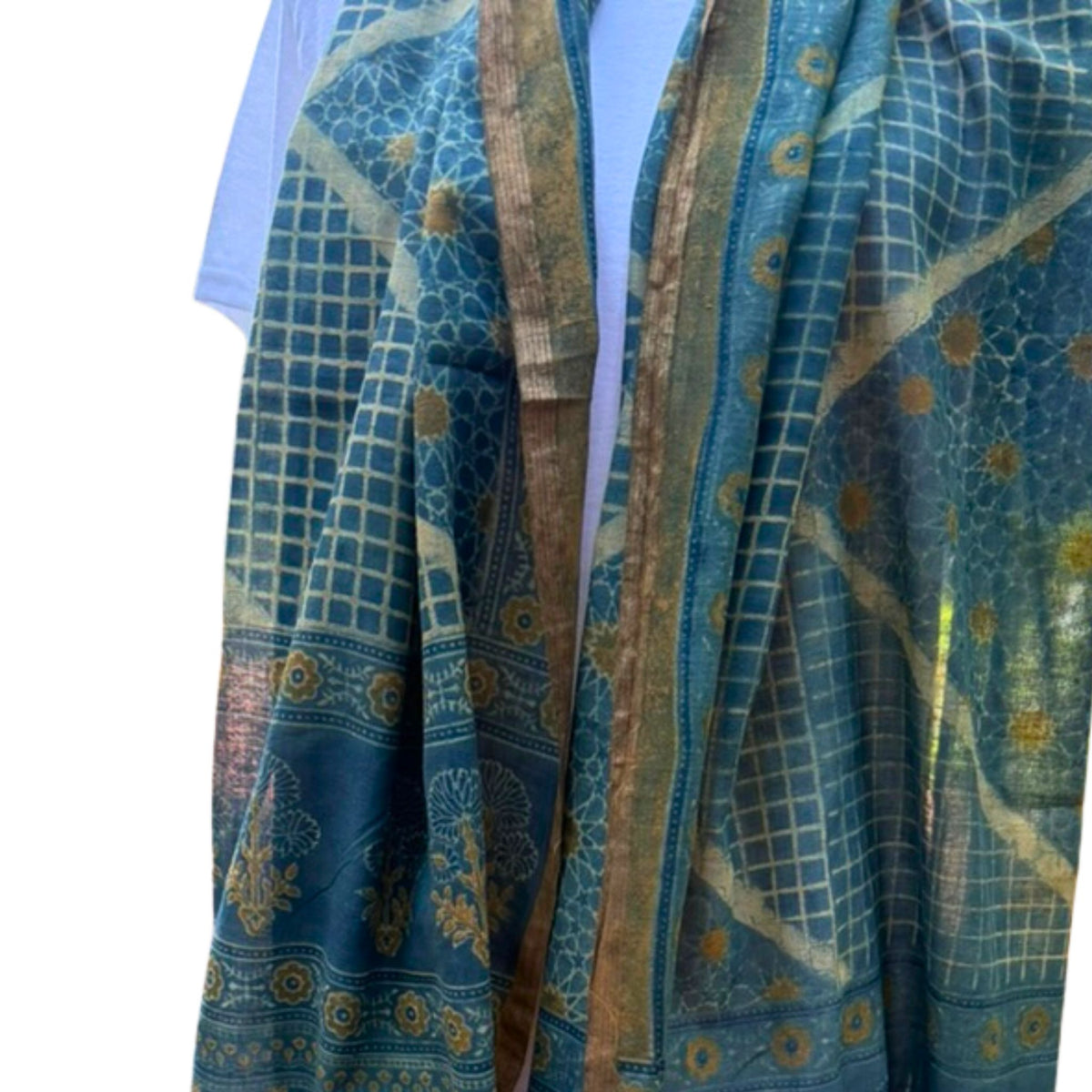
An ajrakh hand block printed cotton scarf in indigo and gold, made by master artisan Sufiyan Khatri in Ajrakhpur, Kuchchh, using natural dyes indigo, myrobalan and possibly pomegranate peel. Wear this natural dye scarf loose over a white shirt and jeans, wrapped twice under a denim jacket, or open across the shoulders.
Block Print Cotton Scarf Details
- Hand block printed in the ajrakh technique by Sufiyan Khatri, Ajrakhpur, Kuchchh, Gujarat
- 100% cotton
- Natural dyes: indigo and myrobalan and / or pomegranate peel
- Soft hand-feel, with a natural drape
- Metallic gold thread detail at the border
- Handmade tassels
- 84" x 27"
- Stocked in the USA and ships free
How to Care for your Block Print Cotton Scarf
Spot clean first if you can. Otherwise handwash very gently and separately in cold water with a mild detergent. Do not soak, wring or squeeze. Drip dry in the shade.
Textile and Artisan Story: Ajrakh Block Printing
What is ajrakh block printing?
Ajrakh is a block printing tradition from Kutch in western Gujarat, and originated in Sindh now in Pakistan. The Victoria and Albert Museum, which holds a set of process samples made by Sufiyan Khatri's father, describes it as a laborious technique involving about fourteen stages. The word comes from the Arabic azraq, meaning blue or azure.
Each stage in the ajrakh printing process involves using wooden blocks to print on cloth. Carved wooden blocks lay down the dye (or in some cases a resist), called for in the design being printed. The resist paste keeps dye off the areas meant to stay pale or reserved for a different dye than the one being applied. Other blocks lay down mordants, which fix color the color to the cloth. Between stages the cloth is washed and dried. What you see on this scarf is the sum of those stages in motifs that mix traditional patterns with newer geometric ones.
Natural dyes
Except for a short period during the 1970s, ajrakh printing always used natural dyes: from local plants, fruits, roots and minerals like iron. The colors in this scarf are from plants as well: Indigo for the blue, myrobalan and/or pomegranate peel for the warm tones. Natural dyes vary, so small differences along the length of the cloth are normal.
Sufiyan Khatri, tenth generation ajrakh printer
Sufiyan Khatri is the tenth generation of his family to print ajrakh. He learned it in his father's workshop in Ajrakhpur, and he now travels to teach it, including at the International Folk Art Market in Santa Fe. His work has been awarded a UNESCO Seal of Excellence.
His father, Dr Ismail Khatri, holds an honorary doctorate from De Montfort University in Leicester, awarded in 2003 for his work in block printing and for mentoring apprentices. A set of his ajrakh process samples is in the permanent collection of the Victoria and Albert Museum in London.
Ajrakhpur, the village named after the cloth
The printer community originally settled in and worked at Dhamadka until the 2001 Gujarat earthquake, after which the water there came back heavy with iron. Too much iron in the water is detrimental to the vibrancy of natural dye colors.. A large part of the printing community moved, re-built their home and heritage and named it after the cloth.
Share